




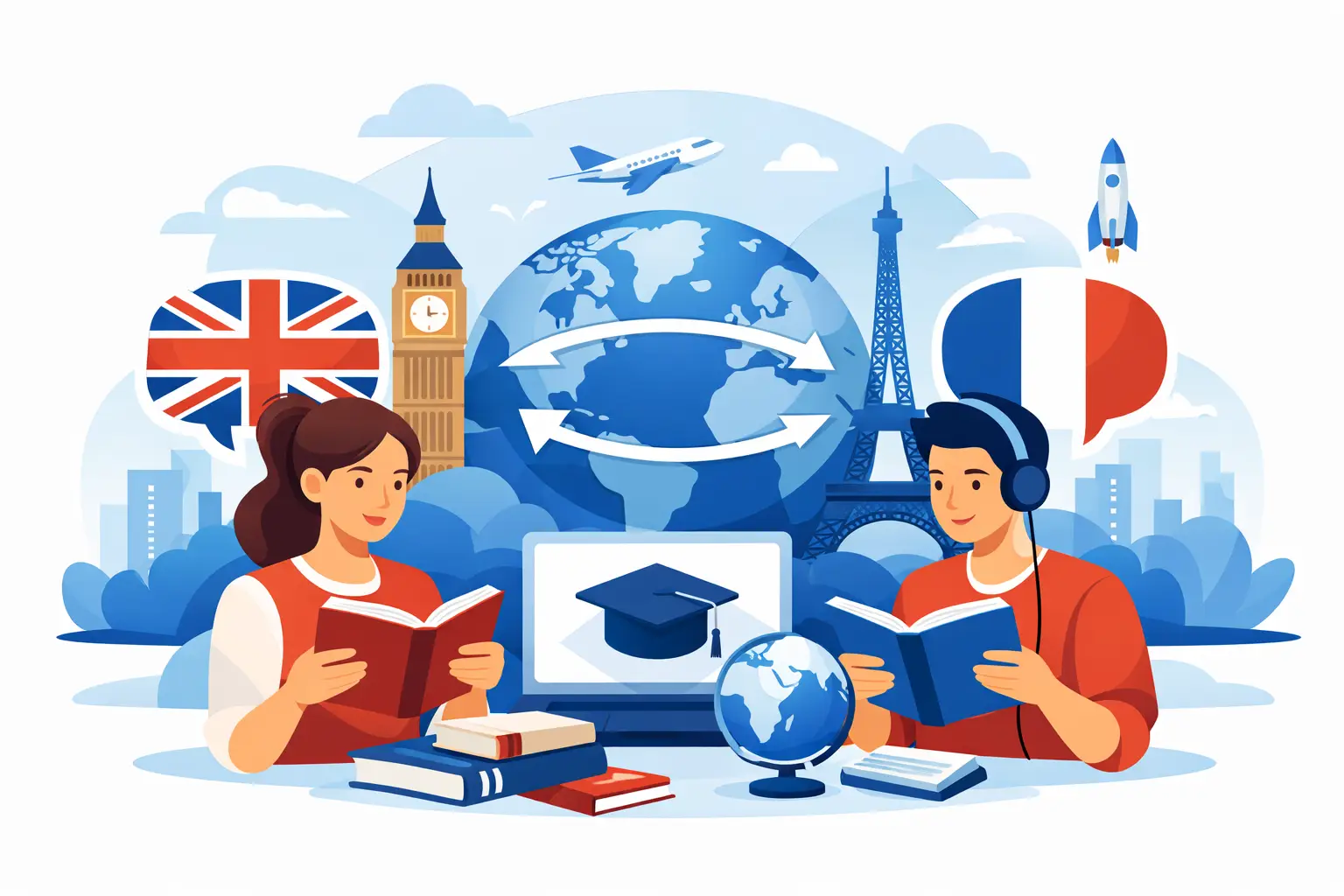
A child who can discuss a science experiment in English, explain it clearly in French, and feel confident in both settings has more than two languages. They have greater access to ideas, relationships, and future choices. For families in Abidjan with international ambitions, bilingual education English French is not an extra activity after school. It is a long-term academic advantage that should be built with care.
The strongest bilingual programs do not ask children to simply memorize vocabulary or switch languages for the sake of it. They create a secure, structured environment where students learn demanding subjects, express their thinking, and develop the confidence to participate fully. That distinction matters, especially when a child is preparing for an American diploma, university applications, or a future that may cross borders.
Why English-French bilingual education matters
French is central to daily life, culture, and professional opportunity in Côte d’Ivoire and across much of Africa. English opens access to international higher education, global business, research, technology, and a wide range of academic resources. A student who develops real proficiency in both can move more confidently between local roots and global opportunities.
For parents, the benefit is not only linguistic. Learning in more than one language can encourage children to listen carefully, compare ideas, and adapt to different audiences. These skills are valuable in classrooms, interviews, team projects, and leadership roles. They also help students see that there can be more than one way to describe a problem or reach a solution.
However, bilingualism is not automatically achieved because a school offers English classes alongside French. True progress requires regular exposure, purposeful instruction, patient support, and time. Children need opportunities to use English for meaningful academic work, not only greetings and simple conversation. At the same time, their French language development and cultural identity should be respected as strengths, not treated as obstacles.
What effective bilingual education English French looks like
A quality program begins with a clear academic language. In an American international school, English may be the principal language of instruction because it supports a coherent pathway toward an American High School Diploma and Advanced Placement courses. For many families, this creates a direct connection between early learning, high school achievement, and university readiness.
Yet an English-focused academic environment should not leave newly enrolled French-speaking students to manage alone. Effective language integration provides a bridge. Children need teachers who assess their current level, set realistic goals, and help them participate from the first day. Visual supports, modeled language, guided reading, small-group instruction, and opportunities to rehearse answers can make rigorous content accessible while English is still developing.
The goal is not to simplify the child’s potential. It is to provide the right support so that potential can emerge. A student may understand advanced mathematics or demonstrate strong curiosity in science before they have the English words to show it. Personalized instruction allows teachers to recognize that ability and build the language needed to express it.
Language learning should continue across subjects
Children learn most effectively when language has a purpose. A student who reads a novel, conducts an experiment, presents a historical argument, or collaborates on a design project is using English as a tool for thinking. This is far more powerful than studying isolated grammar alone.
French also retains an important role. It supports family communication, local connection, and intellectual depth. Depending on the child’s age and previous schooling, a bilingual pathway may include French literacy development, French cultural learning, and opportunities to transfer concepts between languages. Strong schools help students understand that their languages work together rather than compete.
Confidence is part of academic progress
Some children arrive at an English-language school excited but quiet. Others may resist speaking because they are worried about making mistakes in front of classmates. This is normal. A protective school environment gives students permission to try, revise, and grow without embarrassment.
Small classes and attentive teachers can make a meaningful difference. When educators know each child well, they can notice whether a student is silent because they are shy, confused, new to English, or simply processing a difficult idea. The response should be thoughtful, not one-size-fits-all.
Choosing the right path for your child
The best bilingual option depends on your child’s age, current language level, learning profile, and your family’s long-term plans. A preschool child can often acquire spoken English naturally through daily routines, stories, songs, play, and interaction. An older student may need more explicit academic language support, particularly if they are entering a grade where essays, laboratory reports, and complex readings are expected.
Parents should ask practical questions. What happens when a student enrolls with little or no English? How is progress assessed? Are language supports available within the school day? Can the program support a midyear transition? What diploma will the student earn, and how will it be recognized by universities internationally?
The answers reveal whether a school is prepared for the realities of bilingual learning. A promising brochure is not enough. Families need evidence of a coherent curriculum, qualified educators, a safe campus culture, and an individualized plan that allows their child to belong while progressing.
There is also a trade-off to consider. Full language immersion can accelerate English development, but the first months may feel demanding, especially for older children. A program that protects well-being while maintaining high expectations offers the best balance. Students should be challenged, but they should never feel that asking for help is a failure.
From early confidence to university readiness
Bilingual education has its greatest impact when it is viewed as a continuum rather than a short-term goal. In the early years, children build listening skills, vocabulary, social confidence, and a positive relationship with learning. In elementary school, they use language to read independently, solve problems, and collaborate. By middle and high school, they need the academic precision to write arguments, analyze sources, participate in discussions, and communicate with maturity.
This progression is especially valuable for students pursuing internationally recognized university pathways. Admissions teams look beyond a student’s ability to speak English. They consider academic preparation, intellectual curiosity, writing, course rigor, leadership, and the capacity to contribute to a diverse community. A student educated in a demanding English-language curriculum, while grounded in French and their own cultural perspective, can bring a distinctive strength to that process.
At IUDSchool, language integration is designed to welcome students at different entry points, including those who are beginning their English journey. The purpose is not merely to help children catch up. It is to help them build the academic confidence and global perspective expected of future leaders.
How families can support bilingual growth at home
Parents do not need to turn the home into a second classroom. Consistency and encouragement matter more than pressure. Keep French rich and present through conversations, books, family stories, and everyday discussions. A strong first language supports thought, identity, and later learning in English.
Create natural moments for English as well. Younger children may enjoy English story time or age-appropriate educational programs. Older students can discuss a topic they studied, keep a reading routine, or practice presenting an idea aloud. The key is to make language a living part of daily life, not a test to be passed.
Most importantly, celebrate effort. When children see that errors are part of learning, they are more willing to speak. That willingness becomes confidence, and confidence creates momentum.
A carefully planned English-French education gives children a rare advantage: the ability to remain connected to where they come from while being prepared for where they may go. The right school partnership can make that future feel not distant, but possible.
🐦 Kicau Mania
Nikmati suara burung terbaik setiap hari! Rawat, latih, dan cintai burung kicauanmu.