




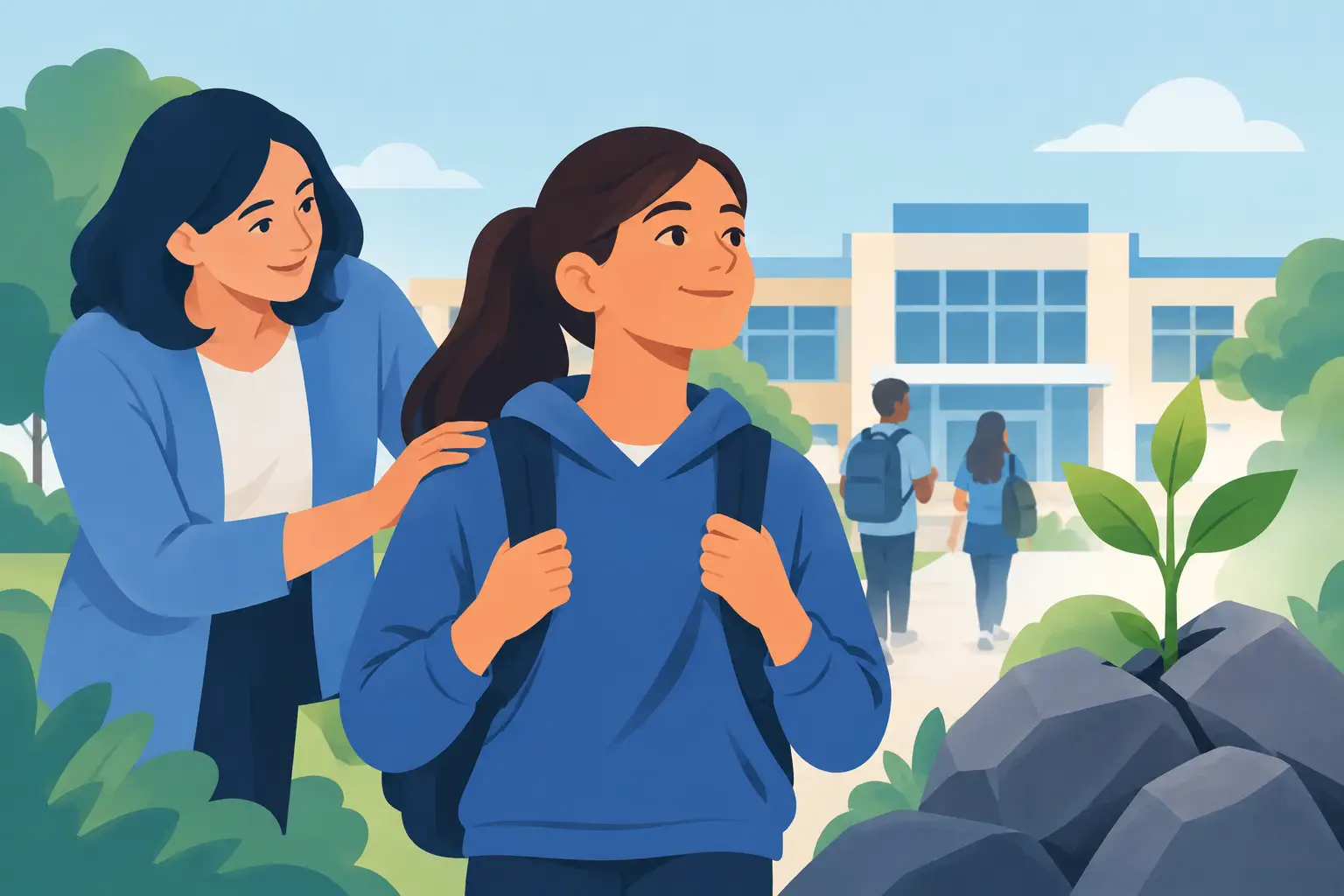
A disappointing test result, a difficult transition to a new language, a missed place on a team – these moments can feel enormous to a child. They are also opportunities to build a lasting capacity: the confidence to recover, adapt, and keep moving forward. For families considering how to foster student resilience, the goal is not to remove every obstacle. It is to ensure that children have the security, skills, and support to meet challenges without losing faith in themselves.
Resilience matters well beyond the classroom. Students who learn to manage setbacks are better prepared for demanding coursework, changing social situations, university applications, and the realities of an international future. They learn that a difficult moment is information, not a definition of who they are.
What Student Resilience Really Means
Resilience is sometimes mistaken for toughness or the ability to handle everything alone. In fact, resilient students know when to ask for help, how to name what they are feeling, and how to try again with a different strategy. They do not need to be fearless. They need to believe that challenges can be understood and managed.
For a child entering a new school, this might mean raising a hand despite limited English. For an older student, it may mean responding constructively after receiving feedback on an essay or AP assessment. The context changes, but the underlying skill remains the same: staying engaged when progress is not immediate.
Children develop this capacity gradually. It grows through repeated experiences of facing an appropriate challenge, receiving thoughtful support, reflecting on what happened, and discovering that they can move forward.
How to Foster Student Resilience Through Belonging
A child is more willing to take academic and social risks when they feel safe, known, and valued. This is why resilience begins with relationships, not pressure. Students need adults who notice changes in behavior, listen without rushing to solve every problem, and communicate a steady belief in their potential.
At school, this is strengthened by teachers who know their students as individuals. Small class settings can make a meaningful difference because educators can recognize when a normally confident learner becomes quiet, when a student is avoiding a task, or when a new arrival needs extra encouragement to participate.
At home, parents can create the same foundation with simple, consistent conversations. Instead of beginning with, “What grade did you get?” try asking, “What felt challenging today?” and “What did you do when it got hard?” These questions signal that effort, reflection, and growth are worthy of attention.
Belonging is especially important for children adjusting to a new country, curriculum, or language. They may be highly capable but temporarily unable to show everything they know. Patient language support, welcoming peer connections, and clear routines help them regain confidence while they build new skills.
Offer Challenge Without Overwhelm
Children do not become resilient by being protected from difficulty, but neither do they thrive when demands consistently exceed their support. The most productive challenge sits in the space between what a student can already do independently and what they can do with guidance.
This balance depends on the child. A student who has recently joined an English-language program may need visual instructions, additional time, and opportunities to rehearse before speaking to the class. Another may be ready for a more complex research project, leadership role, or advanced course. Both are developing resilience when expectations are clear and success feels attainable through effort.
Adults can help by breaking large tasks into manageable stages. A long-term assignment becomes less intimidating when a student can first choose a topic, then locate sources, create an outline, draft, and revise. The child still experiences responsibility, but the path forward is visible.
It also helps to be precise with praise. “You worked hard” is encouraging, but “You revised your introduction after feedback and your argument became clearer” teaches students which actions led to improvement. Specific feedback builds a practical belief in growth.
Let Students Experience Productive Struggle
There is a difference between productive struggle and unnecessary frustration. Productive struggle asks a student to think, practice, and persist. Unnecessary frustration occurs when instructions are unclear, support is unavailable, or the task is far beyond the student’s current readiness.
When a child says, “I can’t do this,” resist the urge to immediately take over. A more helpful response may be, “You cannot do it yet. Which part feels hardest?” This opens the door to problem-solving. Perhaps the student needs an example, a reminder of a prior skill, a short break, or help identifying the first step.
The message is not that adults should leave children alone with their struggles. It is that support should build independence rather than replace it.
Teach the Language of Emotions and Recovery
Resilient students can recognize their emotional responses before those feelings become overwhelming. Younger children may need help distinguishing disappointment from embarrassment, or worry from anger. Older students benefit from learning that anxiety before a presentation or examination is common and can be managed.
Emotional awareness does not lower academic standards. It enables students to meet high standards with greater self-control. A child who can say, “I am frustrated because I do not understand the directions,” is more likely to seek clarification than to disengage.
Useful recovery habits are often simple: pausing for a few slow breaths, taking a brief walk, writing down the problem, talking with a trusted adult, or returning to the task after a planned break. The right approach depends on the student and the situation. What matters is helping children develop a personal set of strategies they can use independently over time.
Adults should also model calm recovery. When parents and teachers acknowledge their own mistakes respectfully – “I misunderstood that, so I am going to correct it” – children see that errors are manageable. This is more powerful than telling them not to worry about failure.
Make Reflection Part of Learning
Resilience grows when students connect effort with learning. After a difficult project, competition, or social experience, reflection helps them move beyond a simple judgment of success or failure.
A short conversation can be enough. Ask what went well, what was difficult, what support was useful, and what the student would change next time. This keeps the focus on decisions and strategies rather than fixed ability. Over time, students become more accurate judges of their own progress.
Reflection is particularly valuable in an academically ambitious environment. High-achieving students can sometimes interpret anything less than perfection as failure. They need adults to reinforce that excellence includes revision, persistence, intellectual curiosity, and the humility to learn from feedback.
Build Resilience as a Shared Partnership
The strongest results come when home and school communicate consistently. Parents should feel comfortable sharing major transitions, concerns, or changes that may affect a child’s confidence. Teachers, in turn, can offer observations about learning habits, peer relationships, and classroom participation.
This partnership should not appear only when there is a problem. Regular communication helps families celebrate progress that may not show up immediately on a report card: a child volunteering an answer, completing work more independently, making a new friend, or recovering more quickly from disappointment.
At IUDSchool, a rigorous American education, individualized attention, and a supportive international community create the conditions in which students can grow academically and personally. For children building English proficiency, adapting to a new school, or preparing for the next stage of their education, this balance of care and high expectations is essential.
A resilient child is not one who never struggles. It is a child who knows that challenge can be faced, support can be sought, and progress remains possible. When adults offer both steady encouragement and meaningful responsibility, students carry that belief with them into every new classroom, community, and opportunity ahead.
🐦 Kicau Mania
Nikmati suara burung terbaik setiap hari! Rawat, latih, dan cintai burung kicauanmu.