




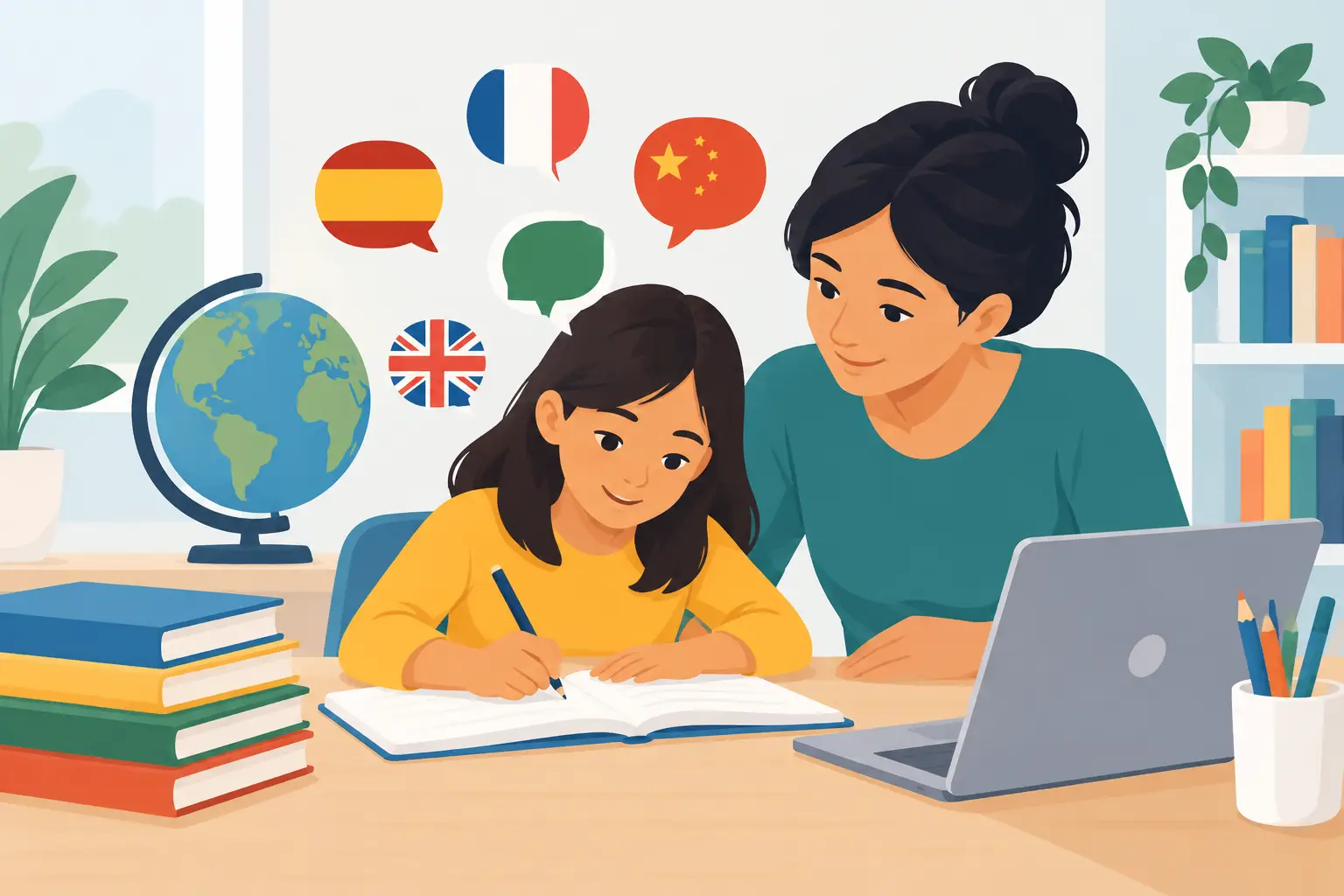
A child may explain a science idea brilliantly in French at the dinner table, then hesitate when asked to write the same answer in English. That pause is not a lack of ability. It is often the natural work of moving between languages, vocabulary, and academic expectations. To support multilingual homework routines, families need more than extra worksheets. They need a calm structure that protects confidence while building the language skills required for long-term success.
For internationally minded families, homework can become a valuable bridge between home life and an American academic program. Done well, it helps children develop independence, strengthen English, and see their home language as an asset rather than an obstacle. Done poorly, it can turn each evening into a stressful translation exercise. The difference lies in the routine.
How to Support Multilingual Homework Routines at Home
The most effective homework routine is predictable, short enough to be sustainable, and adapted to the child’s current English level. A student who is new to English may need more spoken practice, visual support, and parental reassurance than a student who has already developed academic fluency. Neither child benefits from a rushed, high-pressure approach.
Begin with a regular homework window after the child has had time to eat, rest, and reconnect with the family. For younger learners, 20 focused minutes may be more productive than an hour at the table. Older students can work for longer periods, but they still benefit from planned breaks, especially when reading or writing in a second language requires intense concentration.
Create one consistent study space with the materials the child needs: charged device, books, pencils, paper, and a bilingual or learner-friendly dictionary when appropriate. This does not need to be a separate room. A quiet corner of the dining table can work well if it is free from television, frequent interruptions, and competing conversations.
Just as important, make the routine visible. A simple sequence such as snack, review the assignment, complete the first task, take a short break, and check the work gives children a sense of control. When a child is managing two or more languages, clear structure reduces the mental load of deciding what to do next.
Let Understanding Come Before Perfect English
Parents sometimes worry when a child first thinks through homework in French, Arabic, Spanish, or another home language. In many cases, this is a sign of active learning. Children use the language they know best to understand a difficult concept before they express it in English.
If a Grade 4 student understands fractions in French, the family should not erase that understanding in the name of English-only homework. Instead, help the child connect the concept to the English vocabulary required by the assignment: numerator, denominator, equivalent fraction, compare. The goal is not to replace one language with another. It is to build a strong pathway between them.
That said, the final expectations of the assignment matter. If the task asks for an English paragraph, the child should practice producing the final response in English. Parents can invite the child to explain the idea first in the language that feels most natural, then help organize the English response. This protects comprehension while steadily expanding academic English.
Avoid translating every word automatically. Constant translation can make a child dependent on an adult and can slow the development of independent reading strategies. Instead, encourage the student to identify what they understand, underline unfamiliar words, use context clues, and ask focused questions. A child who learns to say, “I understand the question, but I do not know what ‘justify’ means,” is developing an essential academic skill.
Use Questions That Build Thinking
The most helpful parent is not the one who supplies every answer. It is the one who asks the right questions. Try: “What is this question asking you to do?” “Show me where you found that idea in the text.” “Can you explain your answer aloud before you write it?” These prompts work across languages and help children organize their thinking.
When correction is needed, choose the priority. If the assignment is about a history argument, focus first on the quality of the argument rather than correcting every article or preposition. If the lesson specifically targets grammar, then accuracy deserves more attention. Children can improve content and language at the same time, but not every error needs to be addressed in every task.
Protect Confidence While Building Independence
Multilingual learners often work harder than their classmates simply because they are processing directions, vocabulary, and subject content at once. A parent who says, “You should know this already,” may unintentionally make the next assignment feel more intimidating. A better message is: “This is challenging because you are learning in more than one language, and you are making progress.”
Praise should be specific. Rather than saying only “Good job,” recognize the strategy the child used: rereading a question, checking a word, planning a paragraph, or asking for clarification. Specific praise teaches students what effective learning looks like and gives them tools they can use when parents are not beside them.
Independence should grow gradually. A new English learner may need an adult nearby to read instructions aloud and confirm the first step. Over time, the adult can shift from sitting beside the child to checking in after the first task, then reviewing the completed work at the end. This gradual release is more effective than either doing the work for the child or leaving them alone with instructions they cannot yet access.
It also helps to separate homework support from perfectionism. A polished assignment completed mostly by an adult may look impressive, but it does not show the teacher what the child can do independently. Honest work, including manageable mistakes, gives educators the information they need to provide the right support.
Keep Communication With Teachers Clear and Practical
Homework routines become much stronger when school and home share the same expectations. If a child regularly spends far longer on assignments than expected, becomes distressed by written directions, or cannot explain what a task requires, let the teacher know. These details help distinguish between a language barrier, a gap in content knowledge, and a workload issue.
Families should feel comfortable asking direct questions: What is the purpose of this assignment? Which vocabulary should my child know? Is it appropriate for my child to discuss ideas in the home language before writing in English? How much parent support is expected? Clear answers prevent families from overhelping or underhelping.
At IUDSchool, a personalized approach to language development can help families understand where their child is in the journey from everyday communication to confident academic English. The most useful school-home partnership is not based on pressure. It is based on shared observation, realistic goals, and steady encouragement.
Notice When the Routine Needs Adjustment
A routine that worked in September may need to change by January. As children become more comfortable in English, they may need less help with vocabulary and more support with planning, research, or time management. Older students taking advanced courses may benefit from a weekly calendar that breaks large assignments into smaller deadlines.
Watch for signs that the routine is becoming unproductive: daily tears, excessive time on simple tasks, avoidance, or a parent-child conflict that begins before the books are even open. The answer is not always more practice. Sometimes the child needs clearer instructions, a shorter work block, a conversation with the teacher, or a different way to demonstrate understanding.
A multilingual home is already a place of intellectual richness. When homework routines honor that richness while maintaining clear English-language expectations, children learn something larger than vocabulary. They learn that they can belong in more than one world, communicate with confidence, and meet demanding academic goals without leaving an important part of themselves behind.
🐦 Kicau Mania
Nikmati suara burung terbaik setiap hari! Rawat, latih, dan cintai burung kicauanmu.