




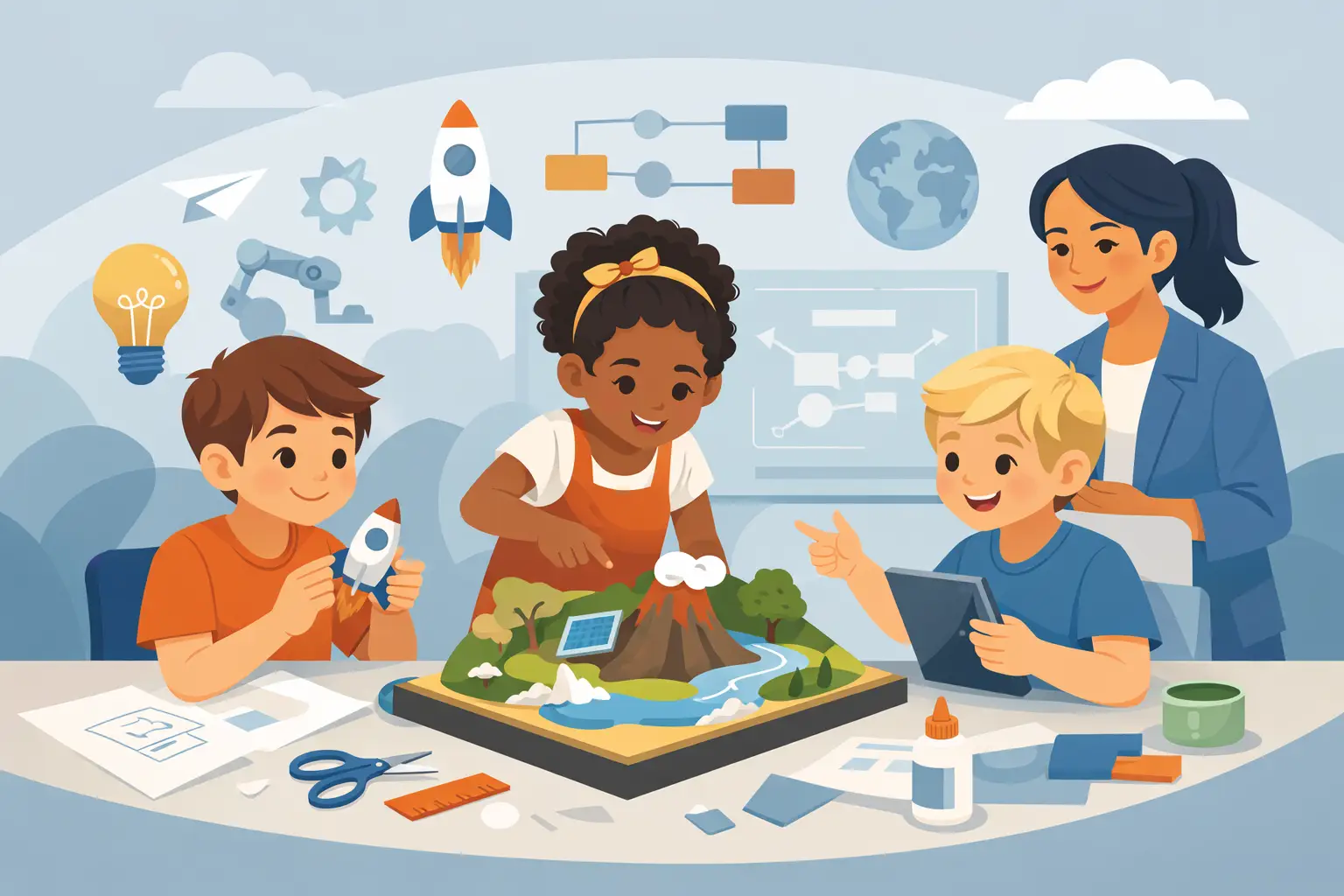
A child who can explain why clean water matters, measure how much a garden needs, and present solutions to classmates is doing more than completing a school assignment. In a strong project based learning elementary school program, learning becomes visible, purposeful, and connected to the real world. For families seeking an international education in Abidjan, this approach can help children build the confidence and habits that support long-term academic success.
Project-based learning does not replace academic rigor with crafts or group activities. When it is thoughtfully designed, it asks students to use reading, writing, mathematics, science, research, and communication to investigate a meaningful question. The final product matters, but the thinking, persistence, and feedback developed along the way matter even more.
What Is Project-Based Learning in Elementary School?
Project-based learning, often called PBL, is an approach in which students explore a complex question or challenge over an extended period. Rather than receiving every answer from the teacher, they investigate, ask questions, test ideas, revise their work, and share what they have learned with an authentic audience.
In elementary school, projects should remain developmentally appropriate. A Kindergarten class may observe insects on campus and create a simple habitat guide. Grade 3 students may study how communities use water, collect data, read nonfiction texts, and propose ways to reduce waste. Grade 5 students may research the history and environmental impact of local food systems, then present evidence-based recommendations.
The strongest projects are not separate from the curriculum. They are a way to bring curriculum to life. A well-planned inquiry can strengthen phonics and vocabulary for younger learners, reinforce multiplication and data analysis for older students, and give every child a real reason to write clearly and speak with purpose.
Why Meaningful Work Builds Stronger Learners
Elementary children are naturally curious. They notice patterns, question how things work, and want to make sense of the people and places around them. Project-based learning respects that curiosity while providing the structure children need to grow.
Academic skills have a clear purpose
A worksheet can assess a skill, but a project can show a child why the skill matters. When students calculate costs for a school garden, they practice operations with numbers. When they interview a community member and write a report, they build listening, note-taking, reading, and writing skills. When they create a model that must withstand a specific test, they apply scientific reasoning and learn from failure.
This does not mean direct instruction disappears. Children still need teachers to introduce concepts, model strategies, teach vocabulary, and correct misunderstandings. The difference is that students then have an opportunity to apply those lessons in a situation that requires judgment rather than memorization alone.
Confidence grows through ownership
A child who has researched a question, overcome a difficulty, and explained a solution to others develops a different kind of confidence. It is not simply the confidence of getting a correct answer. It is the confidence of knowing, “I can work through a challenge.”
This is especially valuable for children adjusting to a new school, a new language, or an unfamiliar curriculum. Small, well-supported responsibilities can help them participate meaningfully from the start. A child may contribute a drawing, a photograph, a measurement, or a short oral explanation before being ready to write a longer report in English.
Communication becomes a daily practice
The future leaders families hope to raise will need to communicate across cultures, work with different perspectives, and present ideas with clarity. Projects make these skills part of everyday learning rather than an occasional performance.
Students learn to listen when peers have different ideas. They learn to divide responsibilities fairly. They learn that a presentation improves when they rehearse, receive feedback, and revise. These are valuable life skills, but they also support immediate academic performance in a rigorous American curriculum.
Project Based Learning Elementary School Programs and Bilingual Growth
For multilingual learners, project-based learning can create an encouraging bridge into English. Language has a practical function during a project: students need it to ask, describe, compare, label, explain, and share. This gives new vocabulary a meaningful context.
Visual materials, demonstrations, partner work, sentence frames, and hands-on investigations allow children to engage before they have complete fluency. At the same time, teachers can maintain high expectations by explicitly teaching the academic language required for each stage of the work.
There is a balance to protect. Group projects should never allow a child with limited English to remain silent while others carry the academic work. Effective teachers assign clear roles, check individual understanding, and create multiple ways for students to demonstrate progress. A model, an oral explanation, a labeled diagram, and a short written reflection can each reveal learning at different stages of language development.
At IUDSchool, this kind of structured support aligns naturally with a learning environment designed to welcome students at different entry points and help them progress toward bilingual confidence.
What Quality Project-Based Learning Looks Like
Not every activity labeled a “project” offers the same educational value. A colorful poster completed after a unit may be enjoyable, but it is not necessarily project-based learning. The quality of the process determines whether children are challenged academically and supported appropriately.
A strong elementary project begins with a question that is open enough to invite investigation but focused enough for children to manage. “How can we make our classroom more energy efficient?” is more productive than “Learn about energy.” Students need access to reliable resources, explicit instruction, frequent check-ins, and a timeline with manageable milestones.
Teachers also need to assess learning throughout the process. They may review a child’s research notes, listen to a conference with a group, check mathematical calculations, or ask students to explain a decision. This protects academic accountability and helps teachers give timely support before a misconception becomes a larger problem.
The final presentation should have a real purpose. Students might share ideas with another class, parents, school leaders, or a relevant community audience. Knowing that others will see their work often encourages children to take greater care, but the audience must remain supportive. Elementary students need room to take intellectual risks without fearing embarrassment.
The Role of Teachers and Families
Project-based learning can look independent from a distance, but it requires highly skilled teaching. The teacher is not stepping away. The teacher is carefully planning the experience, providing instruction at the right moment, asking questions that deepen thinking, and ensuring that each child is included.
At home, families can support the process without taking over. Ask your child what question their class is investigating and what evidence they have found. Invite them to explain a challenge they are facing. If research or materials are needed, help them organize their time, but allow the final ideas and work to remain their own.
Parents may also notice that a project feels less predictable than a traditional workbook. That can be a positive sign, provided the school communicates clear learning goals and assessment standards. The purpose is not to make learning harder for its own sake. It is to help children transfer knowledge, make decisions, and become more capable with each new challenge.
Choosing the Right Balance for Your Child
Project-based learning is powerful, but it works best as part of a balanced educational program. Young students still benefit from systematic reading instruction, guided practice in mathematics, teacher-led discussions, and opportunities to build foundational knowledge. A project cannot compensate for gaps in core instruction.
The right question for families is not whether a school uses projects occasionally. It is whether projects are purposeful, age-appropriate, connected to academic standards, and supported by strong teaching. Families should look for an environment where curiosity is welcomed, expectations are clear, and children are known well enough to receive the guidance they need.
When children are given meaningful problems, careful support, and a safe place to share their ideas, they begin to see school as more than a place to receive information. They begin to see themselves as capable learners who can understand their world and contribute thoughtfully to it.
🐦 Kicau Mania
Nikmati suara burung terbaik setiap hari! Rawat, latih, dan cintai burung kicauanmu.